
Amazon Sponsored Prompts: What They Are, Why They Matter, and How Brands Should Act

Amazon is constantly evolving how shoppers discover and buy products. The latest innovation? Sponsored Prompts, an AI-driven retail media ad product designed to meet shoppers in the moment they ask questions — and guide them to your products. For brands, this isn’t just another ad placement; it’s a fundamental shift in how retail media works on Amazon.
In this blog, we’ll explain what Sponsored Prompts are, why they’re important, and most importantly, what brands should do to leverage them effectively.
What Are Amazon Sponsored Prompts?
Sponsored Prompts are a new retail media product that layers AI-generated, conversational product prompts on top of your existing Sponsored Products and Sponsored Brands campaigns.
There are two main types:
Sponsored Products Prompts – These are product-specific, feature-focused prompts that highlight a SKU’s benefits and use cases. For example, a prompt could answer a shopper’s question like, “Why is Product X great for travel?” and surface your advertised product in the response.
Sponsored Brands Prompts – Broader prompts that can showcase multiple SKUs or your brand store, positioning your brand as the answer to a category-level question.
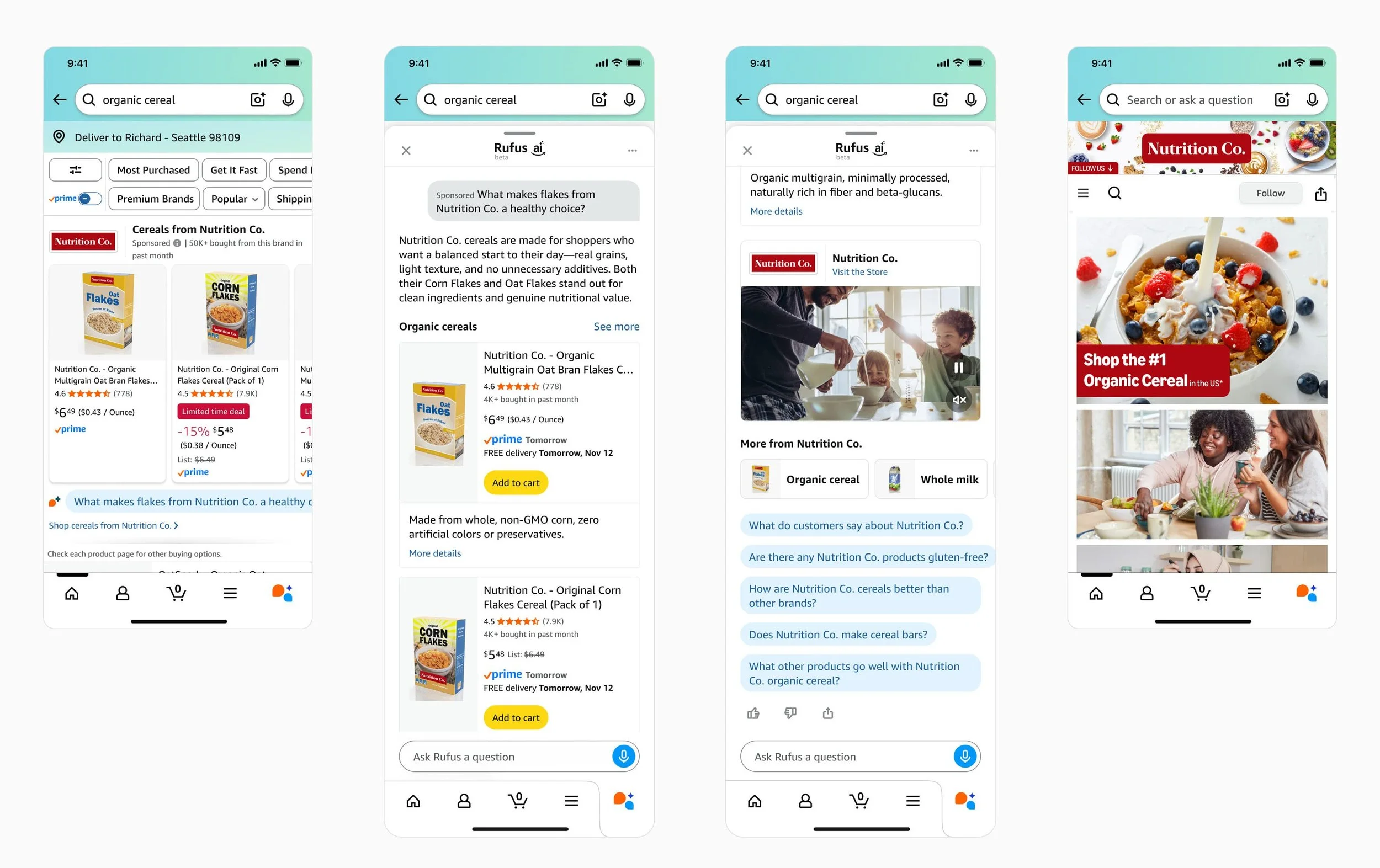
These prompts are tied directly to your campaign keywords, product pages, and brand content. Amazon automatically enrolls campaigns in Sponsored Prompts, though advertisers can opt out if needed. Performance metrics like impressions, clicks, and purchases are now available in the Ads Console, letting brands measure and optimize the impact of these AI-driven interactions.
In short: Sponsored Prompts aren’t just another ad placement. They are an AI-powered, conversational layer that turns product content and campaign signals into real-time, purchase-driving recommendations.
Why Sponsored Prompts Matter
Sponsored Prompts are important for three main reasons:
1. They Shift Discovery to Conversational Commerce
Historically, shoppers discovered products by typing keywords, scanning search results, and clicking. Amazon’s shopping assistant, Rufus, and other conversational interfaces are changing that. Shoppers now ask questions in natural language and expect actionable answers. Sponsored Prompts meet shoppers in these moments, delivering ad-driven product suggestions at the point of inquiry.
This “agentic” commerce is different from traditional search: it’s interactive, conversational, and discovery-focused. For brands, this means your product can be recommended before a shopper even types a keyword — if your content is optimized.
2. They Leverage High-Intent, First-Party Signals
Amazon’s retail media success is built on intent. Shoppers are often close to purchase, and Sponsored Prompts capitalize on that intent. The prompts are grounded in product pages, brand stores, and your campaign keywords, ensuring recommendations are contextually relevant.
Amazon advertising is enormous — its ad revenue exceeded $50 billion annually in 2024, making it the third-largest digital ad platform behind Google and Meta. Even a small lift in conversions through Prompts can have meaningful revenue impact.
3. They Expand Upper- and Mid-Funnel Influence
Sponsored Prompts can deliver benefit-led messaging that educates shoppers — for example, “What makes Product X the best choice for travel?” This positions your brand early in the decision-making process while still enabling a purchase.
Brands that optimize for Prompts can capture both consideration-stage and purchase-ready shoppers, providing a competitive advantage in crowded categories.
Key Data Points
To understand the scale and impact of Sponsored Prompts, consider:
Amazon Ads generated $17.7 billion in Q3 2025, continuing strong growth and illustrating the platform’s massive reach.
Amazon’s AI shopping assistant, Rufus, is used by hundreds of millions of shoppers, showing the behavioral shift toward conversational, agent-driven commerce.
Existing Sponsored Products and Sponsored Brands campaigns are automatically enrolled in Prompts, and Amazon now provides prompt-specific performance metrics in the Ads Console.
These numbers highlight that Sponsored Prompts aren’t experimental — they are live, scalable, and measurable.
What Brands Should Do: A Tactical Playbook
Optimizing for Sponsored Prompts requires a multi-step approach. Here’s a practical guide:
1. Audit and Optimize Product Pages (Immediate)
Sponsored Prompts draw from PDP content, A+ content, bullets, and brand stores. Ensure:
Titles and bullets clearly communicate use cases and differentiators (e.g., “lightweight, TSA-friendly travel coffee maker”).
FAQ-style content exists in A+ content or bullets to provide natural answers for AI prompts.
Images and feature callouts are clear, as AI assistants may summarize visual information.
This is low-effort with high potential impact — prompts will naturally surface content already present on your pages.
2. Prioritize “Explainable” SKUs (1–3 Weeks)
Not every product performs equally well in prompts. Focus on SKUs that are:
Unique in their category (distinct features or formulations)
High-margin or strategic (bundles, subscriptions)
Backed by strong reviews and content
Promote these SKUs first in Sponsored Products and Brands campaigns to maximize prompt-driven exposure.
3. Adapt Copy for Conversational Discovery (2–4 Weeks)
Think in Q&A format instead of standard ad headlines. Examples:
Question: “Why is Product X best for travel?”
Answer: “Lightweight, TSA-approved, 12-hour battery life.”
Incorporate this phrasing into bullets, A+ content, and brand stores so the assistant has clear, ready-to-use text.
4. Measure Prompt Performance Separately (Ongoing)
Sponsored Prompts are a distinct placement. Track:
Impressions and clicks
CTR and conversions
ROAS attributed specifically to prompts
Use these metrics to compare prompt-driven results with traditional search placements and refine campaigns accordingly.
5. Test Keywords and Audiences (1–3 Months)
Because prompts are conversational, broaden keyword sets to include intent-focused, long-tail phrases, like “best portable espresso for camping.” Test lifestyle keywords and audience segments in Sponsored Brands to capture conversational discovery moments.
6. Maintain Brand Safety (Immediate)
AI-generated prompts can occasionally misrepresent your products. Brands should:
Monitor the Prompts tab and opt out of any misleading content
Ensure Brand Registry and product attributes are accurate to avoid AI “hallucinations”
This protects your brand while allowing automated discovery to work effectively.
Recommended Experiments
Prompt vs Search Split Test: Run identical creative and keywords to compare performance when appearing via prompts versus SERP placements.
Message Lift Test: Modify one bullet into a Q&A style and measure lift in prompt-driven clicks and purchases.
Upper-Funnel Influence Test: Measure new-to-brand customers and assisted conversions for SKUs with optimized prompts.
These experiments help validate the incremental impact of Sponsored Prompts on sales.
Risks and Considerations
Default Opt-In: Amazon automatically enrolls campaigns. Check prompts early to prevent poor-quality AI recommendations.
Consumer Perception: Some shoppers may view AI-surfaced ads differently than traditional search ads, impacting brand trust.
Attribution Challenges: Early-stage prompt metrics may under- or over-credit conversions; compare to baseline attribution methods.
30/60/90-Day Roadmap
30 Days: Audit PDPs, update bullets for Q&A style, confirm Prompts tab visibility, opt out of low-quality prompts.
60 Days: Prioritize top SKUs, run initial A/B tests, build measurement dashboard for impressions, clicks, purchases, and new-to-brand metrics.
90+ Days: Scale what works, refine conversational copy, align upper-funnel content with agentic shopping paths, and expand successful strategies across more SKUs.
The Bottom Line
Sponsored Prompts represent a structural shift in Amazon retail media. They embed AI-powered, ad-driven recommendations into conversational shopping moments, connecting shoppers to your products earlier in the decision process.
For brands, this is not just a new placement — it’s a new way of capturing intent. Optimizing content, experimenting with conversational copy, and tracking prompt-specific performance now will give early movers a competitive edge.
If you’re serious about winning on Amazon in 2025 and beyond, Sponsored Prompts are a must-activate part of your retail media strategy.