
Why AI-Powered Shopping Changes Everything

Recent advances in generative AI are ushering in a new era of “agentic commerce.” Rather than typing keywords into a search bar, more shoppers are beginning to rely on natural-language AI assistants that interpret intent, sift through catalog data, and even guide the entire purchase journey.
A “commerce GPT” — a cross-retailer AI assistant — can surface products from multiple stores, compare specs, and recommend based on use-case, not just keywords.
Retailer-specific AI agents like Amazon Rufus and Walmart Sparky are already live, operating within their respective ecosystems to help shoppers ask questions, compare items, and complete purchases conversationally.
According to recent reporting, traffic to U.S. retail sites from generative-AI browsers and chat services surged 4,700% year-over-year (as of July 2025), and these users are more engaged: spending 32% more time on-site, browsing 10% more pages, and bouncing 27% less.
For brands — especially those on marketplaces — this shift isn’t a “nice-to-have”; it’s rapidly becoming a must. If PDP content isn’t AI-ready, products risk invisibility when shoppers turn to AI to discover or compare items.
What “AI-Ready” PDPs Look Like
So what does “AI-ready” mean in practice? Based on how AI agents ingest and surface product data, brands should approach PDPs as structured dossiers — not just as sales copy. Here’s what to prioritize:
1. Comprehensive, structured metadata
AI assistants don’t “see” a page like a human. Instead, they parse structured data: titles, bullet-point specs, category attributes, compatibility lists, dimensions, materials, colors, variants, etc.
PDPs should therefore include:
Clear, standardized titles (brand + product type + key spec)
Full spec sheets or bullet-point details (size, weight, materials, compatibilities, variant distinctions)
High-quality attribute metadata (color, size, variant, weight, dimensions, compatibility)
Structured variant feed (so each SKU/variant is clearly separated)
Standardized taxonomy/attributes aligned with marketplace schema
This structured detail ensures that AI agents can confidently compare, filter, and surface products in response to natural-language prompts.
2. Rich, benefits-driven — but factual — copy & use-case context
Beyond just specs, AI agents — especially “commerce GPTs” — are increasingly capable of understanding context and user intent. For example, a shopper might ask: “Find me a waterproof backpack under $80 for hiking and weekend trips.” An AI that can deliver good recommendations will need: spec data plus context about use case.
Brands should therefore treat PDPs as mini-briefs: not just “what” a product is, but “when” and “why” it matters. Include use-case hints, benefits-based bullet points, and ideal scenarios. This gives AI more context to recommend thoughtfully.
3. Review data and social proof (where allowed) exposed in structured ways
AI shoppers often act more like comparison-shopping professionals: they weigh features, but they also value social proof. When product reviews, ratings, and citations are embedded or structured (e.g., “4.8/5 stars, over 250 reviews — praised for durability and lightweight design”), those signals help AI agents surface the best options rather than just the first matching spec.
If your product page doesn’t include or expose reviews/ratings clearly — especially in structured metadata — you risk losing the “social proof uplift” in AI-mediated shopping.
4. API / feed completeness, catalog hygiene, and variant-level granularity
Because agentic commerce often relies on feeds and catalog ingestion (rather than page-by-page human browsing), brands must ensure their data feed is clean, complete, and variant-level granular.
Missing SKUs, inconsistent variant naming, or incomplete metadata will cause exclusion or mis-ranking in AI recommendations. As one industry perspective puts it, the winners of the agentic commerce era will be those who have “data quality, structured content, and operational precision.”
The Business Case: Why Brands Should Care — Now
The scale is massive and accelerating
Studies estimate that AI-powered shopping agents could unlock hundreds of billions in new commerce. One projection suggests “agentic AI commerce” could top $180 billion annually, rivaling the online sales of some of the largest retailers.
Everyday usage is already humming — tens of millions of product-related queries occur daily through chat-based agents, and conversion potential is real.
For brands, that means there’s a huge, fast-growing opportunity to be discovered by AI-powered shoppers — but only if product data and PDPs are optimized accordingly.
Shoppers are already comfortable using AI for retail
According to a recent consumer survey, 29.3% of U.S. adults report regularly using generative AI. Among subscribers to major commerce platforms (e.g., Amazon Prime, Walmart+), the rate is even higher — around 34–35%.
That suggests a growing base of shoppers who prefer AI-guided shopping experiences, especially within marketplaces.
Agentic commerce may redefine how visibility, discovery, and advertising work
Traditional e-commerce success — at least on marketplaces — has hinged on mastering keyword SEO, click-driven ads, and bidding strategies. But as AI agents drive the bulk of discovery, those levers may shift.
As one expert analysis notes: the era of “SEO” may give way to “AEO” — Answer Engine Optimization. Rather than optimizing for human search strings, brands will optimize for AI-interpretable structures and semantics.
For small and emerging brands (BirdDog’s core clients), this is a chance to enter the game early, build high-quality product data, and gain visibility among AI-driven shopping flows — even against larger, more established competitors.
Practical Checklist: How Brands Should Make PDPs AI-Ready
Here’s a practical checklist for ecommerce brands — especially those operating near marketplaces like Amazon, Walmart, or via multi-channel integrations — to prepare for agentic commerce:
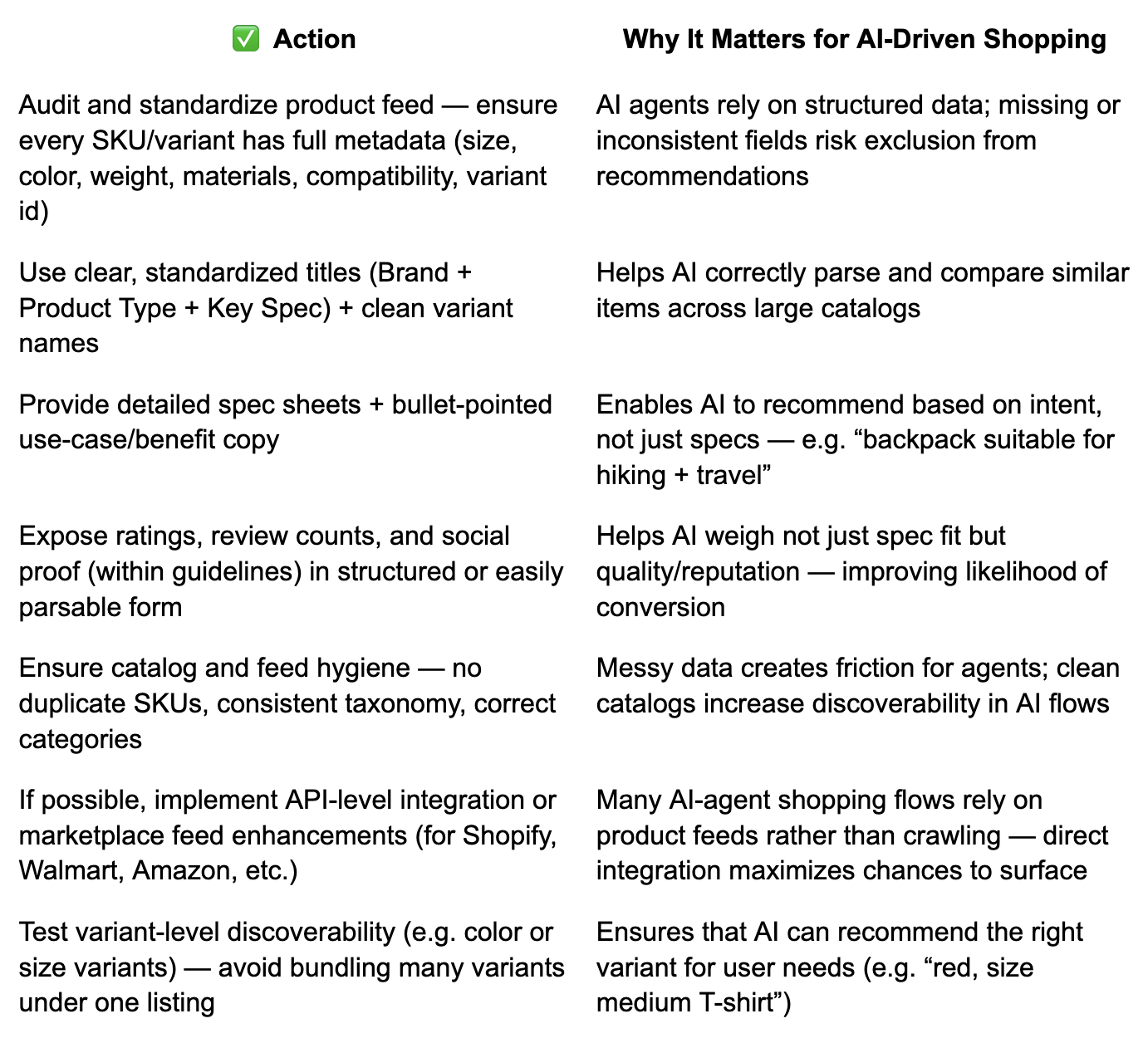
What This Means for Brands & Agencies
For many of our clients and emerging brands, the biggest advantage of being “AI-ready” is first-mover benefit. As marketplaces evolve and AI-driven shopping becomes the dominant paradigm, early adopters with well-structured data and thoughtfully crafted PDPs are likely to capture disproportionately more visibility and share.
Here’s how BirdDog can help:
Feed Audit & Cleanup: We can audit your existing product feeds, identify missing metadata or variant inconsistencies, and standardize taxonomy so every SKU is AI-agent friendly.
PDP Optimization as AI-Native Content: We treat PDPs not as SEO web pages but as structured content — reorganizing spec sheets, normalizing titles/variants, framing benefit/use-case copy to align with agentic shopping logic.
Variant Strategy and Catalog Hygiene: For brands using multiple variants (colors, sizes, materials), we help re-architect how variants are presented — ensuring each variant is discoverable and distinct in the feed.
AI-Aware Launch Strategy: For new product launches, we build from day one with AI-readiness in mind — ensuring clean data, feed compliance, strong copy, and review/readability alignment.
Multi-Marketplace & Multi-Channel Integration: Since many agents can source from multiple marketplaces — not just one — we help brands ensure catalog consistency across platforms (e.g. Amazon, Walmart, Shopify) to maximize visibility.
Concerns & Challenges — AI-Readiness Is Not Automatic
While the potential upside is tremendous, there are emerging risks and challenges to navigate:
Control and ownership: As agents mediate the shopping journey (discovery → evaluation → purchase), brands may lose some control over customer experience, data, and relationship. According to recent analyses, there’s a risk of diminished insight into customer behavior and weaker direct customer relationships.
Margin pressure and cross-selling challenges: AI agents may prioritize single-item purchases that meet user intent, reducing opportunities for cross-selling or add-ons that brands often rely on. T
Reliance on feed quality: If product metadata is incomplete or messy, those products simply won’t surface — leading to potential visibility gaps.
Platform dynamics and competition: As many brands and retailers adopt agentic-ready tactics, competition for “agentic shelf space” will intensify — making data quality and feed hygiene baseline requirements, not optional edge cases.
Because of these dynamics, becoming AI-ready shouldn’t be treated as a one-off project — but rather as a long-term strategy and operating standard.
AI Is Remaking the Digital Shelf — Are You Ready?
We’re at an inflection point in ecommerce: the shift from human search-and-scroll to AI-driven, conversational, intent-based shopping is accelerating. Agentic commerce — powered by AI agents like ChatGPT, Amazon Rufus, Walmart Sparky, and other emerging assistants — is no longer sci-fi: it’s rapidly becoming the new default for discovery, evaluation, and purchase.
For brands selling on marketplaces, that means the rules of the game are changing. Long gone are the days when good imagery + optimized keywords + PPC spend guaranteed visibility. The winners in this next era will be those who invest not in flashy presentation but in data hygiene, structured content, and catalog discipline — because AI agents don’t respond to aesthetics as much as they respond to data.
For small and emerging brands — the kind that BirdDog was created to support — this is actually good news. With the right approach, you don’t need huge budgets or massive ad spend. You just need clean, complete feeds + thoughtful PDPs built for AI. That kind of diligence levels the playing field and opens the door to new growth.
If you want help auditing your catalog, restructuring your PDPs, or building an “AI-ready” launch strategy — we’re here to help.

BONUS: Template For Building Your Retail Ready AI Product Detail Page
Here is a complete, optimized PDP (Product Detail Page) template designed specifically for AI-driven shopping environments (ChatGPT, Amazon Rufus, Walmart Sparky, and emerging CommerceGPT-style agents).
This template is built for marketplace use (Amazon, Walmart, etc.) and combines:
Structured data fields
AI-interpretable metadata
Use-case language
Variant-level organization
Review & credibility prompts
SEO + AEO (Answer Engine Optimization) alignment
Marketplace Optimized AI-Ready PDP Template ✅
SECTION 1 — PRODUCT BASICS (STRUCTURED METADATA)
These fields help AI systems understand exactly what the product IS.

SECTION 2 — VARIANT ATTRIBUTES
Ensures AI can recommend the correct version based on customer intent.
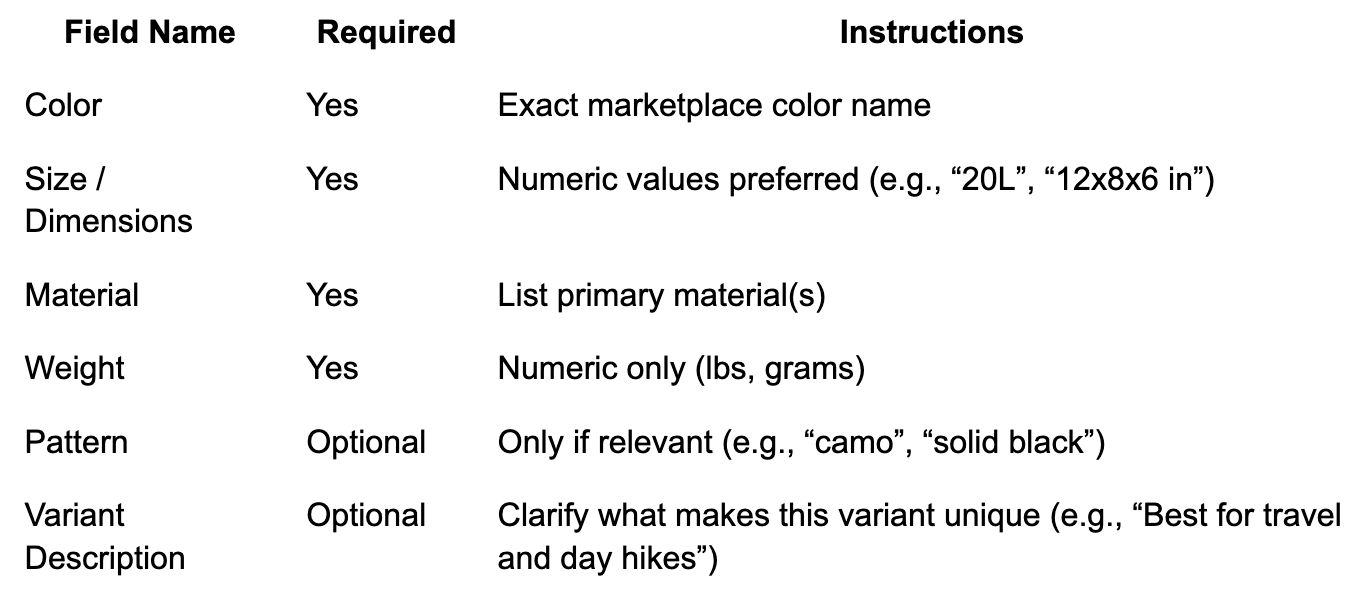
SECTION 3 — PRODUCT FEATURES (AI-INTERPRETABLE)
Write for AI parsing. Avoid fluff. Be factual, measurable, structured.
Key Feature Bullets (5–6 bullets max)
Each bullet should follow this formula:
Feature + Benefit + Use Case
(AI uses all three!)
Example structure:
Waterproof 600D Polyester: Keeps gear dry in rain, ideal for hiking, commuting, and travel.
20L Lightweight Capacity: Weighs only 1.3 lbs for all-day comfort during outdoor adventures.
Ergonomic Padded Straps: Reduces shoulder fatigue on long walks or airport travel.
Multiple Organizer Pockets: Keeps essentials accessible for school, work, or trail use.
Reinforced stitching tested to 50 lbs: Built for durability during heavy daily use.
SECTION 4 — DETAILED SPECIFICATIONS (STRUCTURED)
AI assistants use this section heavily.
Specification
Dimensions (L x W x H)
Weight
Capacity (oz/L/etc.)
Material
Water Resistance Rating
Warranty
Battery Requirements (if applicable)
Compatible With: List compatible devices/systems clearly
Country of Origin
Included Accessories
Certifications
e.g. BPA-free, UL Certified
SECTION 5 — BENEFIT-BASED LONG DESCRIPTION (AEO OPTIMIZED)
Write 3–5 paragraphs focused on:
1️⃣ What the product does
2️⃣ Who it is for
3️⃣ When it is used
4️⃣ Why it is better than alternatives
5️⃣ Proof points
Template Example (replace content as needed):
Meet the [Product Name], a durable, lightweight backpack built for outdoor adventure and everyday use. Designed with waterproof 600D polyester and reinforced stitching, it protects your essentials in unpredictable weather — whether you’re hiking, commuting, or traveling.
With a spacious 20L capacity, ergonomic padded straps, and multiple organizer pockets, this pack is engineered for comfort and convenience on the move. The streamlined design makes it ideal for weekend trips, school use, or long travel days where durability matters.
Every detail is optimized for versatility: side pockets for hydration, a padded sleeve for tablets or small laptops, and quick-access compartments for keys, snacks, or travel documents.
Tested up to 50 lbs of load-bearing strength and backed by a [X-year warranty], this backpack delivers premium performance at a lightweight profile — perfect for active lifestyles.
SECTION 6 — SEARCH/AEO OPTIMIZATION FIELDS
These help AI understand synonyms, intents, and use cases.
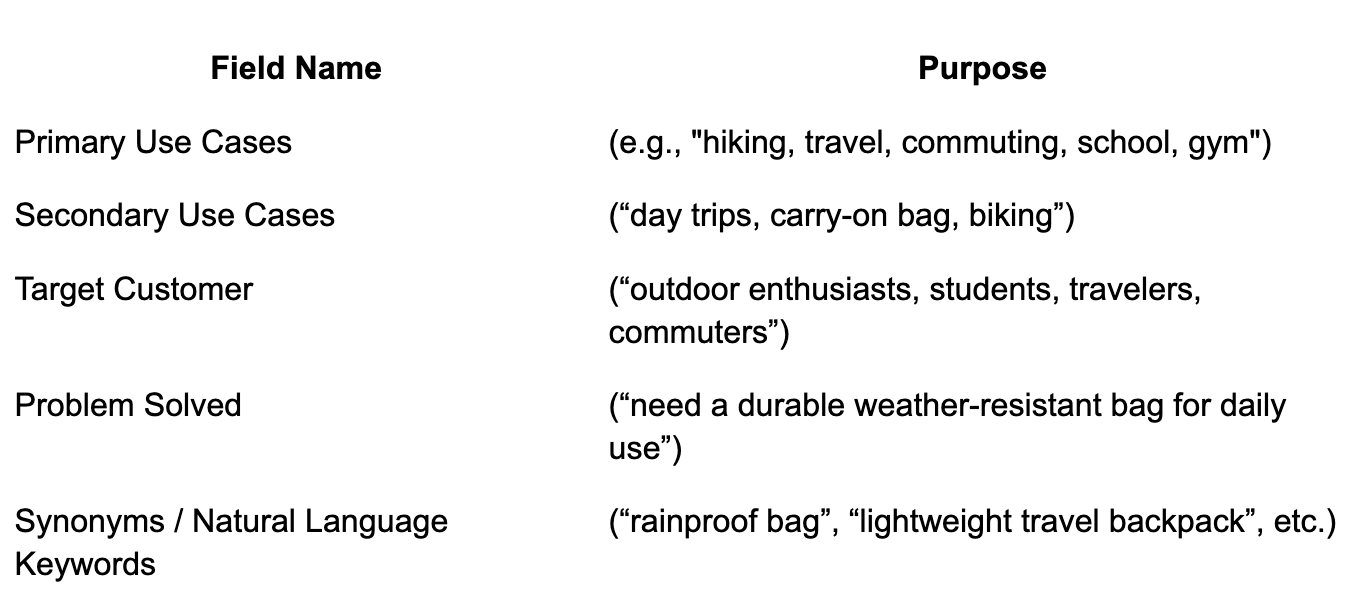
SECTION 7 — COMPARISON POINTS (AI LOVES THIS)
Helps AI answer “Why this instead of X?”
Competitor Comparison Table
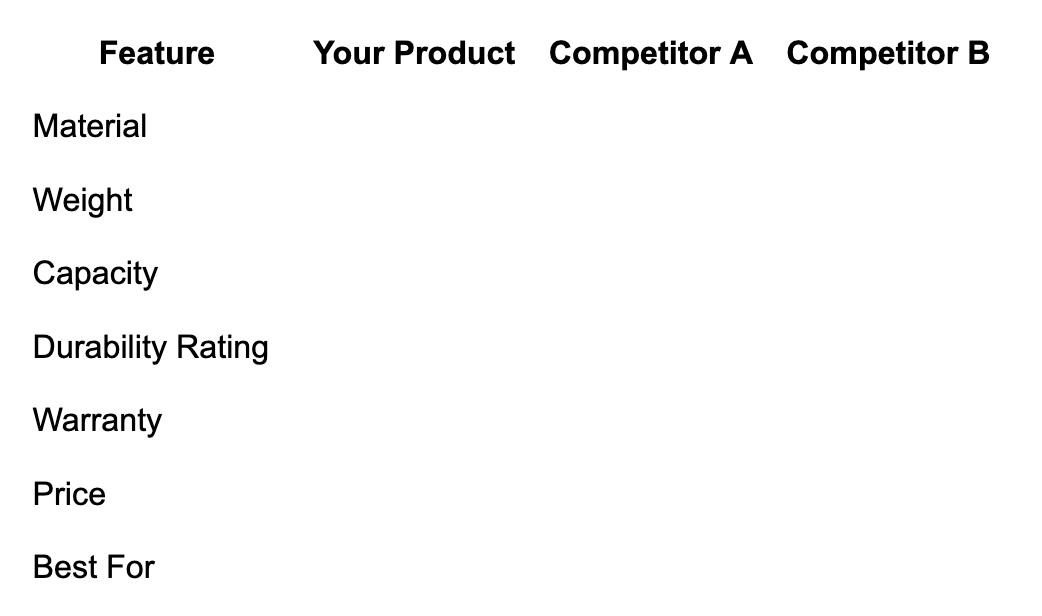
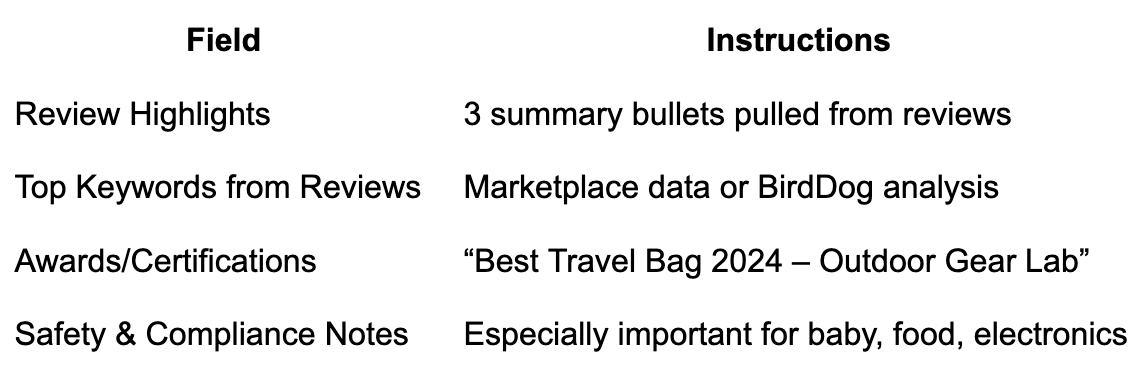
SECTION 8 — SOCIAL PROOF & CREDIBILITY
AI agents frequently surface products with strong, readable proof points.
SECTION 9 — MEDIA ASSETS
Checklist for images & videos:
1 main hero image (white background)
6–8 supporting images
1 lifestyle image per main use case
1 infographic with key features
1 “what’s included” image
1 product video demonstrating use
SECTION 10 — BRAND STORY (OPTIONAL)
Helps AI answer questions about your company:
Fields:
Brand Mission
Sustainability Commitments
Product Development Philosophy
Quality Assurance Standards
Warranty Promise
SECTION 11 — COMPLIANCE & DISCLOSURES
(required for some categories)
Safety warnings
Age restrictions
Material disclosures
FDA/UL/CE compliance info
Country-of-origin labeling
SECTION 12 — OPTIONAL ENHANCEMENTS FOR AI DISCOVERY
These dramatically improve visibility for AI agents:
Q&A Pre-Seeded Database
Add 10–20 FAQs with detailed answers
Product Compatibility Matrix
Multi-intent targeting (“hiking + travel + school”)
Variants labeled with plain-language descriptors (“Best for long trips”)